
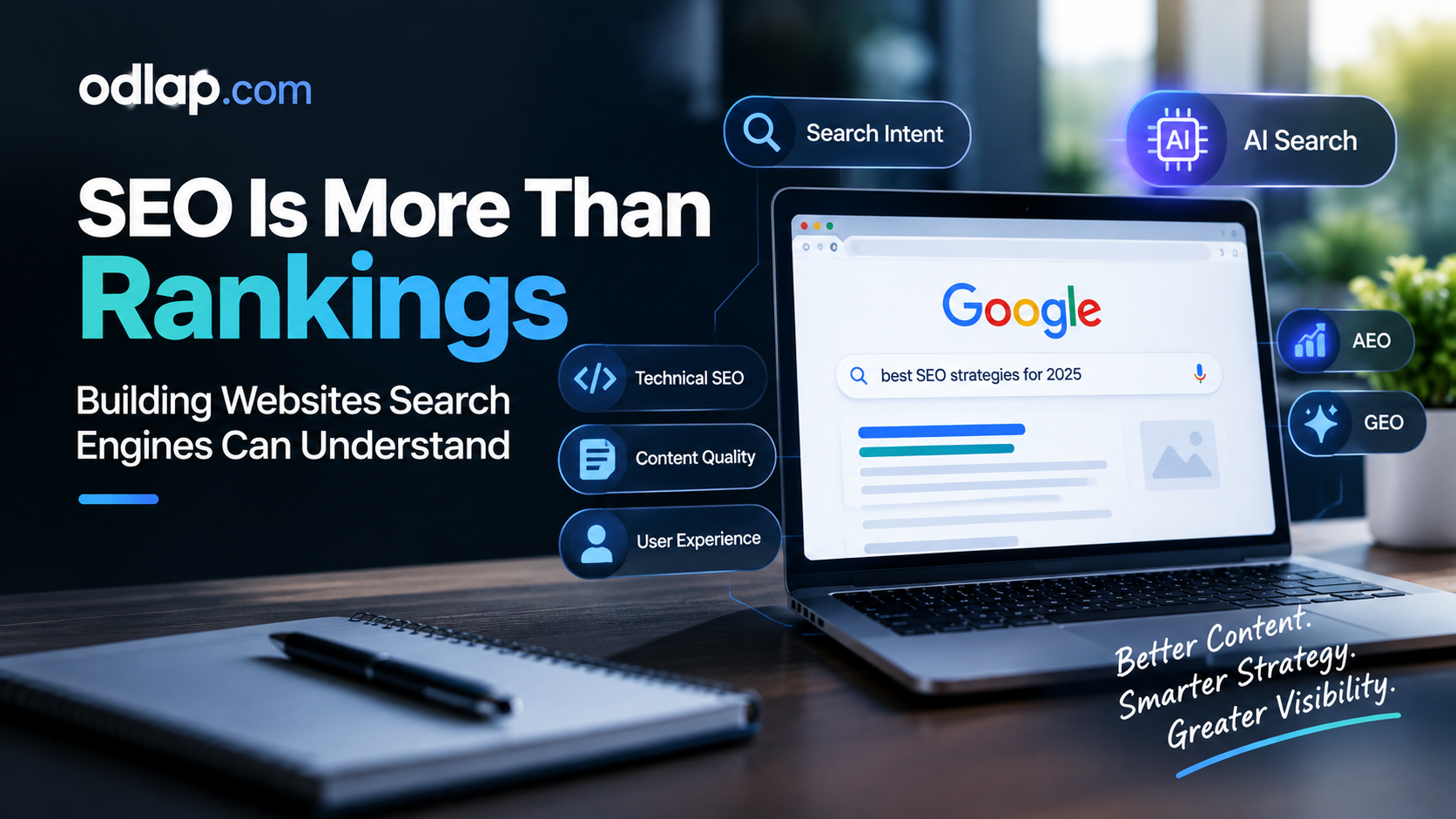
Over the past ten years there has been a dramatic change in search engine optimization. It used to mainly concentrate on keywords, backlinks, and ranking positions but has now developed into a more comprehensive field which incorporates technical performance, content strategy, user experience, search intent and, more and more, artificial intelligence.
At present, successful SEO involves more than just getting a website to appear at the top of Google; it means making the website easy for search engines to crawl, understand, trust, and connect with the appropriate audience.
A major cornerstone of modern SEO is technical SEO. Even if a website has high-quality content, technical problems can stop search engines from properly finding and understanding its pages. Poor site architecture, broken links, duplicate content, wrong canonical tags, slow loading times, and indexing problems are all likely to have a negative impact on organic visibility.
Performance is also important. Measures like Largest Contentful Paint (LCP), Interaction to Next Paint (INP), and Cumulative Layout Shift (CLS) are useful for assessing various aspects of the user experience. If these areas are optimized then the website will not only become more search-friendly but also more usable for visitors.
SEO involves more than just technical optimization.
The next challenge is to understand search intent.
A person looking for “best SEO tools” has a different intention from another person who is searching for “how to perform a technical SEO audit”; the first might be investigating the various solutions on the market, while the second is seeking practical guidance. SEO strategies are more effective when the content focuses on what the user really wants to achieve rather than merely repeating the target keyword.
That is also the reason why content quality is important.
Search engines are now getting better at understanding topics, the relationships between concepts, and the context associated with a query. It is no longer a viable approach to produce content on the basis of a single keyword and to use that keyword repeatedly throughout the page. Nowadays, websites should give useful information, respond to relevant questions, show that they have expertise, and provide original insights which actually assist the reader.
The transformation is being speeded up by artificial intelligence.
People are now making longer and more conversational questions as they use AI-powered search features. Rather than entering just a few words, they might describe the whole problem and expect a full answer. This gives a positive opportunity to websites that present information in a clear way and who show true expertise.
This implies that for SEO specialists, traditional SEO is now being applied to areas like Answer Engine Optimization (AEO) and Generative Engine Optimization (GEO). The goal has moved beyond just securing a blue-link ranking and now includes organising the content so that search engines and AI systems are able to understand the information and recognise the website as a useful source.
Even though these changes have taken place, one principle stays the same: SEO begins with the user.
Algorithms will keep on developing, search interfaces will change and AI will become increasingly integrated into search; however, websites which continually offer accessible, useful, trustworthy and relevant information will still be in a position to compete.
The future of SEO therefore does not lie in deciding between traditional SEO and AI.
The aim is to integrate technical excellence, strategic content, an understanding of search intent, a good user experience, and new AI search technologies into a single comprehensive strategy.
SEO is no longer just about getting a top spot in search results.
What it’s all about is appearing when your audience searches for you.
Leave a Reply